News

Lord Byron and his connection with Australia?

On 13th March 2025, my husband and I visited Martindale Hall at Mintaro, a small settlement in South Australia. The Hall was built in 1879/80 for Edmund Bowman Jnr at a cost of £30,000. Built of local sandstone in the Georgian style with Italianate influences. It has 32 rooms. Edmund’s grandparents emigrated from the Lake District in 1829 to Tasmania. In 1837 they arrived in South Australia. Their eldest son also called Edmund, procured 11,000 acres of land around Mintaro and set up a merino sheep stud on the Martindale Station. Edmund senior drowned in the Wakefield River when the young Edmund was only 11 years old. It was while studying law at Cambridge that young Edmund came to love the English lifestyle and having come into his inheritance, i.e. the Martindale Station and a great deal of money, he engaged a London architect to design a home similar to the English manor house. He brought 50 craftsmen from London and 10 carpenters from Victoria, and they completed the house in 23 months. Edmund lived a gracious lifestyle but had to sell up and move out in 1891 because of the drought years, over expansion and the depression in the mid-1880s. The station and house were bought by William Tenant Mortlock for £33,000 as a wedding present for his wife, Rosye Tennant. One of only two sons survived, John Andrew Tennant Mortlock, and he inherited Martindale. He bequeathed the property to the University of Adelaide, who in turn handed it over to the South Australian Government in 1986.

On a table in the living room, there was a picture of 6th Lord Byron George Gordon. This caught my eye, coming from Nottinghamshire where his ancestral seat, Newstead Abbey, is situated. So, I made enquiries with the staff as to why there was a picture of him. I was then informed that he had some connections or friendship with the owners of the Hall; the guide was unsure whether it was the original owner or the subsequent owners.

I found this difficult to believe because Byron was born in 1788 and died in 1824 and the Hall was not built (according to the fact sheet) until 1879/80. The Bowman family, the original owners, did not arrive in Tasmania until 1829, five years after Byron’s death. I have referred to Professor John Beckett, a leading expert on Byron, who cannot recollect any connection with Byron and Australia. I have also referred to a leading book on The House of Byron, by Violet W Walker published in 1988. Once again, I could find no mention of the connection with the Bowman family or Australia.

There was also a suggestion the connection could have been through Cambridge University, but again his dates were a long way before the Bowman family were in Australia. On my return to England, I contacted the present caretakers and conveyed these thoughts to them. I received a very nice email back saying they were trying to sort out the history regarding the Hall and were currently in touch with Flinders University of Adelaide and had been granted funds to investigate the history of Martindale. To date I have not heard anything more. Nevertheless, an interesting topic and certainly not one I expected to find in a remote settlement in South Australia!

Denise Amos

The Twist Fever

Exactly 200 years ago Nottingham was reeling from what became known as ‘The Twist Fever’. In 1809 John Heathcoat was awarded the patent for fourteen years for his invention - the bobbin net machine. During those years anyone adopting something similar was charged up to £30 per annum. Then, on the expiration of the patent in March 1823, the flood gates opened. To build the machines hundreds of mechanics tempted by high wages poured into Nottingham from Sheffield, Birmingham, Manchester and elsewhere. Almost everybody wanted to invest in bobbin net machines. Proprietors of these were tradespeople such as farmers, bakers, butchers, bankers and publicans. There was even a large proprietor from Kent. For a time, the high rewards were shared by machine owners and workmen, the twist hands. Prices and wages had never been so high. Some arrived on horseback and by nightfall were drinking champagne instead of beer. But output soon exceeded demand and by 1825 a return, previously of £5, dropped to a shilling.

Many did not save for a rainy day but quickly dissipated their earnings. One of them composed a telling ditty about that time:

With rum and gin and brandy O, we made the people stare,
And horse and gig so handy O, to take the morning air.
And then with single-breasted coats and spanking new top boots,
And pockets lined with one pound notes, we were the merry shoots.
The bobbin and the carriage hands they scarcely would look down,
Or bend their portly bodies for to pick up half-a-crown;
And if it had but lasted long, I think, they wouldn't stoop
To poor beef-steaks and onions, but they’d
dine on turtle soup.
But to tell the long and short of it, and so to end my song
Among so many twisters, sir, they've twisted it too strong.

Nottingham recovered but for a brief period succumbed to a weakness of capitalism — boom and bust.

This account is compiled from The Date Book of Nottingham, H. Field, and Nottingham Settlement to City, Duncan Gray.

Terry Fry

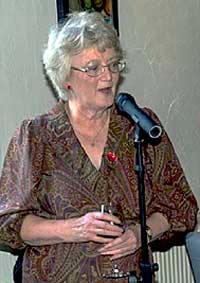
Obituary for Pamela Lewis, 1940-2025

Pam Lewis died at home in Kirkby on June 24, 2025. She was 84. She and husband, Trevor, started the Kirkby & District Archaeological Group in 2009 and became members of the Thoroton Society in 2014 following excavations at the Manor of Kirkby Hardwick, led by Notts County Council archaeologists. Heritage Lottery grants underpinned two further projects: a celebration of the 200th anniversary of the Mansfield & Pinxton Railway in 2019, and a geophysics survey of Castle Hill in Kirkby in 2024 which revealed the footprint of an ancient manor house. Pam and Trevor valued their Thoroton membership and enjoyed many meetings, dinners and outings — most recently to Oxford in 2024.

Pam had a wide variety of interests. She was a life-long activist in the Labour Party and served as County Councillor for Kirkby South from 1981-5. For the following 20 years she and Trevor used their home to offer respite care to older people and people with a learning disability. They also acted as tour managers for some 40 “Learning Journeys” led by Dr Ffiona Eaves, visiting archaeological sites in the Mediterranean and UK.

Pam was heavily involved in voluntary work in the community and was a strong advocate for local heritage and the Conservation Area she lived in. But she is likely to be best remembered as a “people person”, for her friendliness, active kindness and thoughtfulness to all she met.

Trevor Lewis